
Anúncios
Learning to play the piano opens a world of creativity, expression, and mental stimulation that enriches your life in countless ways.


Whether you’ve always dreamed of playing your favorite songs or simply want to explore a new hobby, the piano is an incredibly rewarding instrument. Many people believe that learning piano requires years of expensive lessons and natural talent, but the truth is far more encouraging. With the right approach, dedication, and modern resources, anyone can start playing beautiful music within weeks.
Anúncios
This comprehensive guide breaks down the journey into manageable steps that will take you from complete beginner to confident player. We’ll explore everything from choosing your instrument and understanding basic music theory to developing proper technique and building a sustainable practice routine. Let’s embark on this musical adventure together! 🎹
Understanding Your Instrument Options
Before diving into lessons, you need to choose the right instrument for your situation. The market offers several options, each with distinct advantages depending on your budget, space, and learning goals.
Anúncios
Acoustic pianos provide the most authentic playing experience with natural sound resonance and weighted keys that respond to your touch dynamics. However, they require regular tuning, significant space, and represent a substantial financial investment. Grand pianos offer superior sound quality but are impractical for most beginners.
Digital pianos have revolutionized piano learning by offering weighted keys, headphone jacks for silent practice, built-in metronomes, and recording capabilities at a fraction of the cost. They never need tuning and many models include learning features that accelerate your progress.
Keyboard synthesizers are the most affordable and portable option, though they typically lack weighted keys and the authentic feel of a real piano. They work well for absolute beginners testing their commitment before investing in a better instrument.
Essential Features for Beginner Instruments ✨
When selecting your first piano or keyboard, prioritize these characteristics:
- 88 weighted keys: Full-size keyboards with touch-sensitive keys that mimic acoustic piano resistance
- Sustain pedal compatibility: Essential for proper technique development and expressive playing
- Quality sound sampling: Realistic piano voices that inspire you to practice
- MIDI connectivity: Allows connection to learning apps and music production software
- Adjustable touch sensitivity: Lets you customize the keyboard response as your technique improves
Mastering the Fundamentals of Music Theory
You don’t need to become a theory expert before playing your first note, but understanding basic concepts will accelerate your progress tremendously. Think of music theory as the grammar of a new language—it helps everything make sense.
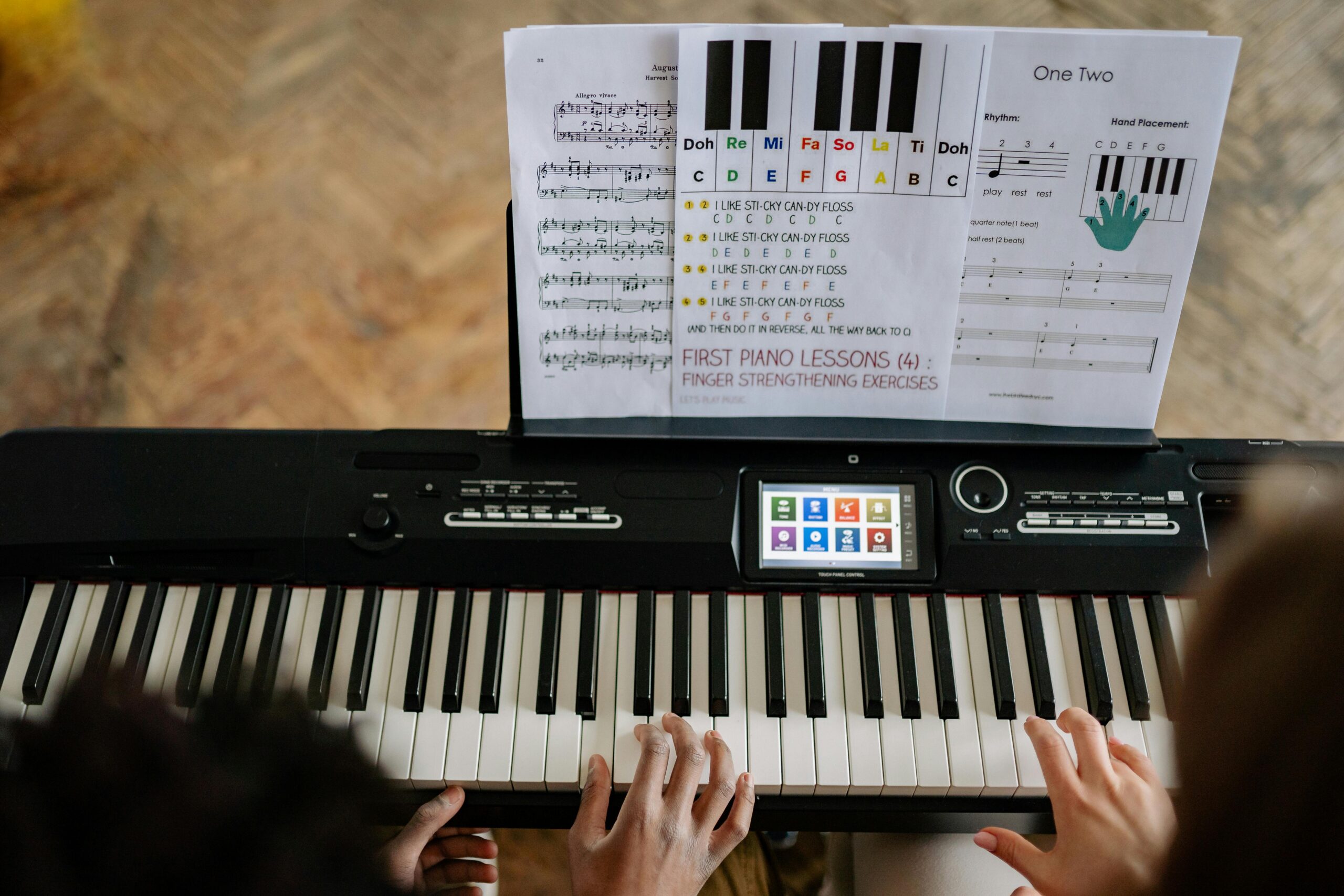
The piano keyboard follows a repeating pattern of 12 notes. Seven white keys (C, D, E, F, G, A, B) and five black keys create each octave. The black keys represent sharps and flats, sitting between most white keys. This visual layout makes the piano one of the easiest instruments for understanding music structure.
Middle C serves as your reference point—it’s the C key closest to the center of your keyboard, typically near the brand name. From there, notes ascend to the right and descend to the left. Learning to locate Middle C quickly is your first practical skill.
Reading Your First Notes on the Staff 📝
Musical notation uses a five-line staff with notes placed on lines and spaces. The treble clef (played with your right hand) sits above middle C, while the bass clef (left hand) sits below. Each line and space represents a specific note.
A simple mnemonic helps remember treble clef lines from bottom to top: “Every Good Boy Does Fine” (E, G, B, D, F). The spaces spell “FACE” (F, A, C, E). For bass clef lines: “Good Boys Do Fine Always” (G, B, D, F, A), and spaces: “All Cows Eat Grass” (A, C, E, G).
Don’t try to memorize every note immediately. Start by learning the notes around middle C, gradually expanding your recognition upward and downward as you progress through simple pieces.

Developing Proper Hand Position and Posture
Good technique prevents injury and makes playing easier as pieces become more complex. Many beginners develop bad habits that limit their progress and cause discomfort, so establishing correct form from day one pays enormous dividends.
Sit at the center of the keyboard with your bench at a height that allows your forearms to stay parallel to the floor when your hands rest on the keys. Your elbows should hang naturally at your sides, never higher than your wrists. Position yourself far enough from the keyboard that you can comfortably reach all areas without leaning.
Curve your fingers as if gently holding a ball, striking keys with your fingertips rather than flat fingers. Keep your wrists level with your forearms—avoid letting them drop below the keys or rise too high. Your hands should feel relaxed, with tension released through your arms and shoulders.
Finger Numbering and Basic Exercises 🖐️
Pianists use a universal numbering system for fingers: thumb (1), index (2), middle (3), ring (4), and pinky (5). Sheet music often includes these numbers to guide fingering, especially for beginners.
Practice this fundamental exercise daily: place your right hand thumb on middle C, then play C-D-E-F-G (fingers 1-2-3-4-5) going up, then back down. Repeat with your left hand starting on the C below middle C. Focus on even tone and smooth transitions between fingers.
Scales represent the foundation of piano technique. The C major scale contains no black keys, making it perfect for beginners. Practice ascending and descending slowly, maintaining curved fingers and listening for evenness in volume and timing.
Creating an Effective Practice Routine
Consistency trumps marathon sessions when learning piano. Twenty minutes of focused daily practice produces better results than two hours once weekly. Your brain needs regular reinforcement to build the neural pathways that make playing automatic.
Structure your practice sessions into distinct segments. Begin with five minutes of warm-up exercises—scales, arpeggios, or finger independence drills. Spend the bulk of your time on new material, breaking challenging sections into small fragments you can master individually. End with something enjoyable, like a piece you’ve already learned, to finish on a positive note.
Use a metronome religiously, even when it feels frustrating. Start tempos painfully slow—slower than you think necessary. Speed comes naturally once your fingers learn the correct patterns. Rushing through pieces with mistakes teaches your hands to play incorrectly.
Smart Practice Strategies That Accelerate Progress ⚡
Hands-separate practice might seem tedious, but it’s the fastest way to learn complex pieces. Master each hand independently before combining them. Your brain can focus on one set of movements at a time, building confidence and accuracy.
Identify the hardest two or three measures in each piece and drill them exclusively. Play them 10-20 times correctly before moving on. Most students waste time playing entire pieces when they only struggle with specific passages.
Record yourself regularly using your smartphone or digital piano’s recording function. Playback reveals errors your ears miss while concentrating on playing. It also documents your progress, providing motivation during inevitable plateaus.
Choosing the Right Learning Resources
The abundance of learning materials can overwhelm beginners. Between traditional method books, YouTube tutorials, mobile apps, and online courses, finding the right combination for your learning style makes a significant difference.
Method books like Alfred’s Basic Piano Library, Faber Piano Adventures, or Hal Leonard Student Piano Library provide structured progression with carefully sequenced concepts. They ensure you don’t skip fundamental skills while offering familiar songs that keep practice engaging.
Mobile apps offer interactive learning with instant feedback that books cannot provide. They gamify practice, track progress, and adapt to your skill level. Many include sight-reading trainers, ear training exercises, and vast song libraries with adjustable difficulty.
YouTube hosts countless free tutorials, but quality varies dramatically. Channels by credentialed piano teachers provide reliable instruction, while others may teach poor technique or oversimplify concepts in unhelpful ways. Verify the instructor’s qualifications before following their methods.
The Value of Private Instruction 🎓
While self-teaching has become increasingly viable, nothing replaces feedback from an experienced teacher. They spot technique problems you can’t see, answer specific questions, and customize lessons to your goals and challenges.
Consider even occasional lessons—monthly or quarterly check-ins with a teacher can correct developing bad habits before they become ingrained. Many instructors now offer video lessons at reduced rates compared to in-person sessions.
Local music schools, community colleges, and university music departments often have affordable group classes for adult beginners. These provide instruction, accountability, and the social benefits of learning alongside peers.
Building Your Repertoire Strategically
Selecting appropriate pieces keeps you motivated without causing frustration. Choose music slightly below your current skill level so you can learn it reasonably quickly while occasionally tackling one challenging piece that pushes your abilities.
Beginner-friendly classical pieces include Bach’s Minuet in G, Beethoven’s Ode to Joy, and Pachelbel’s Canon in D (simplified versions). These develop technique while introducing you to music’s masterworks. Don’t limit yourself to classical music—simplified versions of pop songs, movie themes, and jazz standards make practice more enjoyable.
Balance repertoire across different styles and eras. Classical pieces develop finger independence and dynamic control. Pop songs teach chord patterns and contemporary rhythm. Jazz introduces improvisation and harmonic complexity. This variety prevents boredom and makes you a well-rounded musician.
The Power of Performance Goals 🎯
Set concrete performance deadlines, even if you’re only playing for family. Having a specific date to prepare a piece for creates healthy pressure that focuses your practice. Record a monthly video of your best piece and share it with friends or online communities.
Join online piano communities where beginners share recordings and offer encouragement. The supportive feedback and seeing others at similar levels provides motivation and perspective on your progress.
Consider participating in recitals at local music schools, even as an adult beginner. These events welcome all levels and provide invaluable performance experience that builds confidence and reveals what you can accomplish under pressure.
Overcoming Common Beginner Challenges
Every piano student encounters frustrating obstacles. Understanding that these challenges are normal—and temporary—helps you persist when progress feels impossible.
Hand coordination initially feels like rubbing your stomach while patting your head. Your brain struggles to send different commands to each hand simultaneously. This improves dramatically with practice as neural pathways strengthen. Start with pieces featuring simple left-hand patterns while the right hand carries the melody.
Reading music while playing seems impossibly complex at first. Your eyes must read ahead of what you’re playing, your brain must translate symbols to keys, and your hands must execute accurately—all simultaneously. This skill develops gradually through consistent sight-reading practice with progressively complex material.
Rhythm challenges plague beginners who rush familiar sections and slow down during difficult passages. Metronome practice solves this, though it requires patience. Set the tempo so slow that you can play the entire piece correctly, then gradually increase speed over weeks.
Dealing with Plateaus and Maintaining Motivation 💪
Progress feels linear initially—every practice session brings noticeable improvement. Then you hit plateaus where weeks pass without apparent advancement. This is normal and actually indicates your brain is consolidating skills before the next breakthrough.
During plateaus, shift focus to different aspects of playing. If technical progress stalls, work on musicality—dynamics, phrasing, and emotional expression. If sight-reading frustrates you, spend more time on repertoire you already know, polishing it to performance quality.
Revisit pieces you learned months ago. You’ll be amazed at how much easier they’ve become, providing tangible evidence of your improvement. This perspective helps when current challenges feel insurmountable.
Exploring Advanced Concepts for Continuous Growth
As basic skills solidify, introduce new challenges that expand your musicianship beyond simply hitting correct notes. These concepts transform mechanical playing into genuine artistry.
Dynamics—the variation between soft and loud playing—bring music to life. Practice scales and pieces with gradual volume changes (crescendo and decrescendo). Most beginners play everything at one volume level, missing the emotional impact that dynamic contrast provides.
Pedaling adds richness and sustain but requires careful control. The sustain pedal connects notes smoothly and creates atmospheric effects, but overuse creates muddy sound. Practice lifting the pedal precisely with chord changes to keep harmonies clear.
Ear training develops your ability to play by ear, improvise, and understand music deeply. Spend a few minutes daily identifying intervals, chords, and melodies without sheet music. Apps make this practice systematic and progressive.
Understanding Chord Theory and Harmony 🎶
Learning chord structures unlocks the ability to play countless songs with just a few patterns. Major and minor triads form the foundation—three notes played simultaneously that create the harmonic framework for most popular music.
The circle of fifths reveals relationships between keys and helps you understand why certain chords sound good together. This knowledge accelerates learning new pieces because you recognize patterns rather than memorizing each note individually.
Practice common chord progressions like I-IV-V-I in different keys. Thousands of songs use these same progressions, so mastering them in all keys dramatically expands what you can play and improvise.
Leveraging Technology for Faster Learning
Modern technology provides learning advantages previous generations couldn’t imagine. Smart integration of these tools accelerates progress without replacing fundamental practice.
Piano learning apps offer structured lessons, instant feedback, and progress tracking. They listen through your device’s microphone, identifying correct and incorrect notes while adjusting difficulty to match your improving skills. Many include vast song libraries spanning all genres and skill levels.
Slow-down software lets you practice along with recordings at reduced speeds without changing pitch. This helps you learn complex pieces by allowing your fingers to master patterns gradually before attempting full tempo.
Online communities connect you with fellow learners worldwide. Sharing videos, asking questions, and receiving encouragement from people on similar journeys provides motivation and practical advice that supplements formal instruction.
Your Journey Forward on the Keys
Learning piano represents a lifelong journey rather than a destination. There’s always another level of mastery to pursue, another style to explore, or another challenging piece to conquer. This endless potential for growth makes piano one of the most rewarding pursuits you can undertake.
The path from beginner to accomplished pianist requires patience, consistency, and self-compassion. You’ll have sessions where everything clicks and others where your fingers feel clumsy and uncooperative. Both are essential parts of the learning process. Trust that regular practice—even when it feels frustrating—is building skills beneath the surface that will suddenly emerge in breakthrough moments.
Remember that every pianist you admire started exactly where you are now, struggling with basic finger independence and note reading. Their accomplishments came through the same daily practice sessions you’re undertaking. Your musical voice is unique and valuable, regardless of your technical level.
Start today with realistic expectations and sustainable habits. Even 15 minutes of focused practice daily will transform your abilities over months and years. The piano offers endless beauty, challenge, and satisfaction to those willing to invest the time. Your future self will thank you for beginning this remarkable journey. 🎹✨
